
What Is Strokes Gained? An Explainer for Amateurs
Strokes gained answers one question: on this exact shot, did you do better or worse than a player of your own level would be expected to do from that same spot? Add every shot in a round together, category by category, and you get a number that shows where your strokes actually went, not just how many of them there were.
The problem with just counting strokes
A scorecard tells you what happened: a four on this hole, a six on that one. It doesn’t tell you why. Two rounds of 84 can hide completely different golf. One player wastes strokes off the tee and saves the round with a hot putter. The other drives well and leaks strokes on 100-yard wedges. The scorecard can’t tell them apart. Strokes gained can.
The idea comes from Mark Broadie’s strokes-gained research (Broadie 2011, built on PGA Tour ShotLink data). Every shot starts from somewhere: a lie and a distance. Every shot ends up somewhere closer to the hole. If you know, on average, how many more strokes it takes a player of a given level to finish out from any given lie and distance, you can measure exactly how much closer, or farther, each individual shot left you.
How the math actually works
Say you’re standing on the tee of a 400-yard par 4. Broadie’s Tour data says a scratch-level baseline player needs 3.99 strokes on average to finish that hole from the tee. That’s your starting point. If your tee shot lands in the fairway with 160 yards left, the baseline for finishing out from 160 yards in the fairway is 2.98 strokes. You spent one stroke moving from a 3.99-stroke position to a 2.98-stroke position, so the tee shot was worth 3.99 minus 2.98 minus 1, or plus 0.01 strokes gained: essentially neutral. A great drive that leaves a short iron gains more. A poor one that finds the rough gains less, or loses strokes outright.
That’s the whole method. Repeat it for every shot in the round, sort the shots into tee, approach, around-the-green and putting, and you get a number for each part of your game instead of one blended score.
A worked example, hole by hole
The numbers above are Tour baselines, and applying them straight to a mid-handicap round would be unfair. A 15-handicap golfer doesn’t face the same expected outcomes as a Tour pro from identical spots, so the app scales Broadie’s Tour baselines by handicap: roughly 20% more expected strokes from the tee, about 12% more from the fairway, and a putting baseline that runs about 0.10 strokes higher per green. This is the overlay in the app, on a real hole: the aim line from the tee, the plan’s expected strokes, and how that number compares to par.
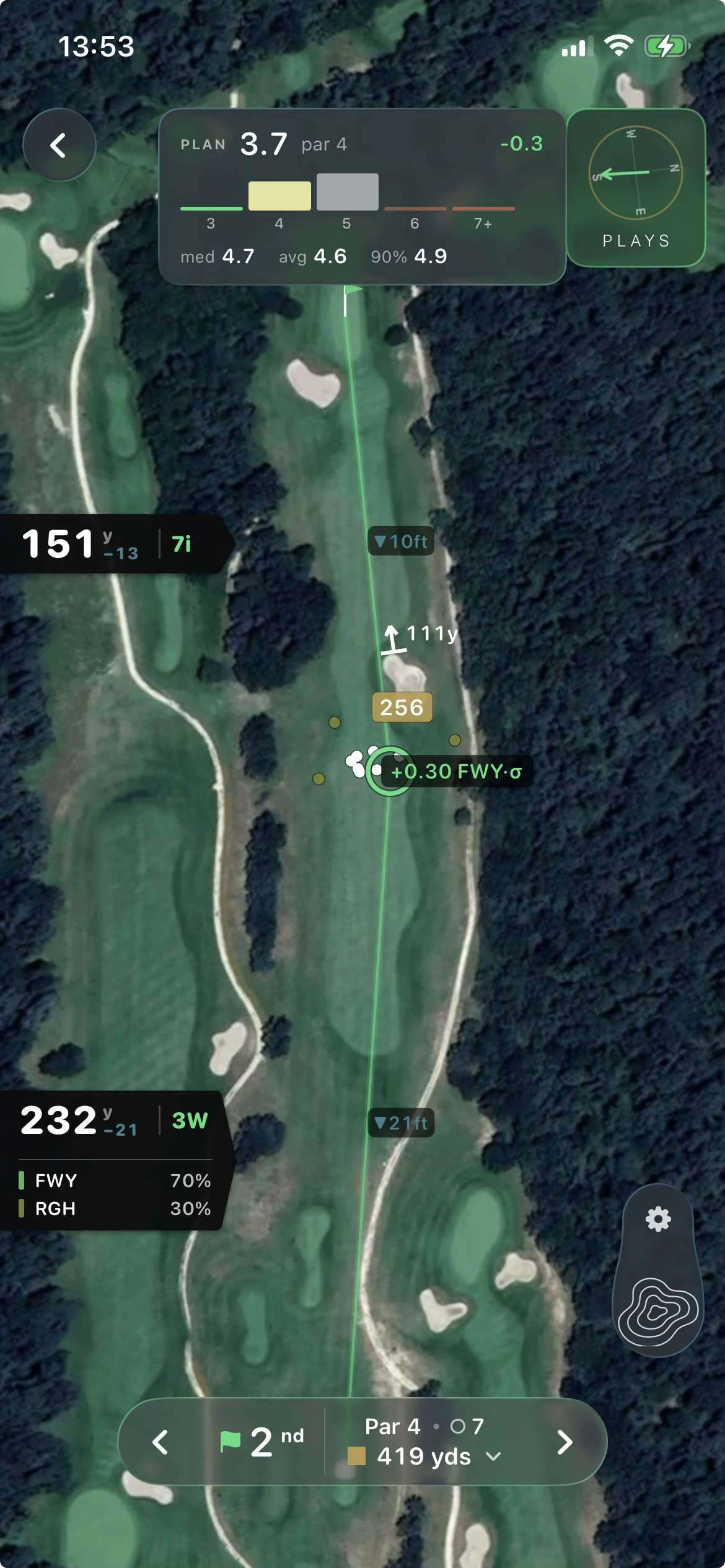
To see the arithmetic behind a number like that, here’s a 400-yard par 4 walked through by hand, for a 15-handicap.
Starting point. Expected strokes to finish the hole from the tee, scaled for a 15-handicap: 3.99 times 1.20, about 4.79.
Shot 1, the tee shot. It finds the fairway with 160 yards left. Expected strokes from there, scaled: 2.98 times 1.12, about 3.34. Strokes gained: 4.79 minus 3.34 minus 1 equals plus 0.45. A tee shot that beat what this player’s own level would predict.
Shot 2, the approach. From 160 fairway, the ball finishes 20 feet from the hole. Expected strokes from 20 feet, with the putting offset: 1.87 plus 0.10 equals 1.97. Strokes gained: 3.34 minus 1.97 minus 1 equals plus 0.37. Another shot ahead of expectation.
Shots 3 and 4, two putts for par. The 20-footer doesn’t drop, but the comebacker does. Expected strokes from 20 feet was 1.97, and actual strokes used to finish out was 2. Strokes gained on the green: 1.97 minus 0 minus 2 equals minus 0.03, essentially average, a routine two-putt.
Add it up: plus 0.45 on the tee, plus 0.37 on the approach, minus 0.03 on the green. The hole card reads a plain par, nothing to remember. The strokes-gained total says this player beat their own baseline by 0.79 strokes on that hole, almost entirely from ball-striking that a scorecard would never show you.
Why this beats fairways hit and greens in regulation
Traditional stats count events: fairways hit, greens in regulation, putts per round. They treat every fairway as equally valuable and every green in regulation as equally easy, and that isn’t true. Missing a fairway by three yards into first-cut rough costs almost nothing. Missing by thirty yards behind a tree costs a full stroke or more. A green in regulation from 8 feet is a different achievement than one from 45 feet, even though both count identically on a stat sheet. Strokes gained folds distance and difficulty into the number itself, so a good result actually looks good and a lucky one doesn’t get overcredited.
What to watch if you’re new to this
You don’t need all four categories at once. Start with whichever one has the widest swings round to round. Most amateurs find their approach-shot numbers move the most, because a 15-handicap’s proximity from 150 yards varies far more than a Tour player’s does. A shot dispersion pattern from a launch monitor session makes that variance visible fast, and it’s usually the fastest way to see which distances are actually costing strokes. Track strokes gained approach for five or six rounds before touching anything else. If putting is dragging every round down by a similar amount, that’s the one to isolate instead. The category with the biggest, most consistent gap between you and your own baseline is the one worth a practice session.
FAQ
Do I need a launch monitor to compute strokes gained? No. You need a lie, a distance, and where the ball finished. A phone GPS and an honest scorecard get you there for tee-to-green categories. A launch monitor session makes the fairway-shot data faster and more precise to log, but it isn’t required to start.
Is a positive strokes-gained number always good? Yes, relative to the baseline it’s measured against. A positive number on a hole means you finished it in fewer strokes than a player of your level would be expected to, given where each shot started. A string of small positive numbers across enough rounds is the real signal, more reliable than any single hot round.
Why doesn’t my handicap move even when my strokes gained looks better? Handicap is a slow-moving average of your best recent scores, gated by course rating and slope. Strokes gained reacts to every shot immediately. You can play a genuinely better round, in the shot-by-shot sense, without shooting a number low enough to move your handicap that week. For more on the gap between the two, see what strokes gained does and doesn’t measure.
Baselines here follow Broadie 2011 (PGA Tour ShotLink data, Table 9), scaled by handicap the same way the app scales them. You can try the scaling yourself in the strokes gained calculator.